Evaluation of Shear Bond Strength of Natural Teeth Versus Zirconia Crown Using Orthodontic Stainless-Steel Bands (Comparative Study)
DOI:
https://doi.org/10.51173/ijmhs.v3i1.84Keywords:
Bond Strengths; Orthodontic Hand; Preformed Zirconia Crown; Natural Teeth; Maximum Load.Abstract
Background: Any disease which leads to loss of tooth structure leads to migration of adjacent teeth in the newly created space. This process leads to impingement of space for the eruption of the succedanea’s dentition leading to malocclusions.
Objective of study: The aim of our study is the evaluation of the ITENA cements as the orthodontic band’s cements on zirconium crowns and compare it with the natural teeth.
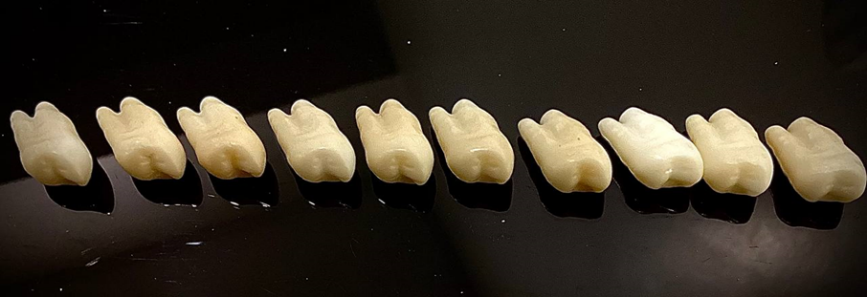
Materials and methods: In the current study, (20) samples were prepared. Natural and zirconia crowns of upper first premolar were performed and used. Performed band was adapted to each tooth. ITENS cement was used, and teeth have been divided into (2) groups: (group A & group B). Orthodontic bands were cemented on natural and zirconia crowns. Before testing, all samples were kept for 24 hrs. at 37°C. All samples were examined in tensile modes by applying the universal testing machines for determining the shear bond’s strengths. All samples were visually evaluated at the cement site following the depending process.
Results: The values of the maximum shear bond’s strength with regard to the maximum loads were shown by natural teeth, and in minimum shear bond’s strength for zirconium teeth, a significant variation was shown between the 2 group (p<0.05).
Conclusions: With regard to maximum loads, the highest values were demonstrated by natural teeth, and lowest by zirconium teeth. This study suggests that the natural teeth were better to use as abutments for space maintainer.
References
Salama, A. A., Shehab, K. A., & Naguib, A. M. (2026). Evaluation of shear bond strength of orthodontic ceramic and metal brackets with zirconia: effects of adhesive systems and storage conditions. Clinical Oral Investigations, 30(4), 131. https://doi.org/10.1007/s00784-026-06783-1.
Casaña-Ruiz, M., Aura-Tormos, J. I., Marques-Martinez, L., Garcia-Miralles, E., & Perez-Bermejo, M. (2025). Effectiveness of space maintainers in pediatric patients: a systematic review and meta-analysis. Dentistry Journal, 13(1), 32. https://doi.org/10.3390/dj13010032.
Zou, J., Meng, M., Law, C. S., Rao, Y., & Zhou, X. (2018). Common dental diseases in children and malocclusion. International journal of oral science, 10(1), 7. https://doi.org/10.1038/s41368-018-0012-3.
Consolaro, A. (2016). Should deciduous teeth be preserved in adult patients? How about stem cells? Is it reasonable to preserve them? Dental Press Journal of Orthodontics, 21(02), 15-27. https://doi.org/10.1590/2177-6709.21.2.015-027.oin.
Babaee Hemmati, Y., Neshandar Asli, H., Falahchai, M., & Safary, S. (2022). Effect of different surface treatments and orthodontic bracket type on shear bond strength of high‐translucent zirconia: an in vitro study. International Journal of Dentistry, 2022(1), 9884006. https://doi.org/10.1155/2022/9884006.
Cantekin, K., Delikan, E., & Cetin, S. (2014). In vitro bond strength and fatigue stress test evaluation of different adhesive cements used for fixed space maintainer cementation. European journal of dentistry, 8(03), 314-319. https://doi.org/10.4103/0970-9290.79979.
Barbería, E., Lucavechi, T., Cárdenas, D., & Maroto, M. (2007). Free-end space maintainers: design, utilization and advantages. Journal of Clinical Pediatric Dentistry, 31(1), 5-8. doi: 10.17796/jcpd.31.1. p87112173240x80m.
Kongkiatkamon, S., Rokaya, D., Kengtanyakich, S., & Peampring, C. (2023). Current classification of zirconia in dentistry: An updated review. PeerJ, 11, e15669. DOI 10.7717/peerj.15669.
Setia, V., Pandit, I. K., Srivastava, N., Gugnani, N., & Sekhon, H. K. (2013). Space maintainers in dentistry: past to present. Journal of clinical and diagnostic research: JCDR, 7(10), 2402.doi: 10.7860/JCDR/2013/6604.3539.
Alharbi, F. (2025). Influence of cement type on the bond strength of orthodontic bands to zirconia crowns. BMC Oral Health, 25(1), 397.https://doi.org/10.1186/s12903-025-05615-0M.
Raut, A., Rao, P. L., & Ravindranath, T. (2011). Zirconium for esthetic rehabilitation: an overview. Indian Journal of Dental Research, 22(1), 140-143.doi: 10.4103/0970-9290.79979.
Emad, B. (2021). The Effect of Zirconia Band and Loop Space Maintainer On Salivary Level of Lactobacillus and Streptococcus Mutans. Al-Azhar Journal of Dental Science, 24(3), 339-344.doi: 10.17796/jcpd.31.1. p87112173240x80m.
Michailova, M., Elsayed, A., Fabel, G., Edelhoff, D., Zylla, I. M., & Stawarczyk, B. (2020). Comparison between novel strength-gradient and color-gradient multilayered zirconia using conventional and high-speed sintering. Journal of the mechanical behavior of biomedical materials, 111, 103977.https://doi.org/10.1016/j.jmbbm.2020.103977.
Klotz, A. L., Halfmann, J., Rues, S., Bömicke, W., Rammelsberg, P., & Zenthöfer, A. (2024). Fracture resistance of posterior tooth-supported cantilever fixed dental prostheses of different zirconia generations and framework thicknesses: An in vitro study. Materials, 17(1), 263. https://doi.org/10.3390/ma17010263.
Kalaskar, R., Ijalkar, R., Kalaskar, A., & Balasubramanian, S. (2021). Comparative evaluation of bond strength of different luting cements for cementation of stainless steel bands on primary molar crowns (stainless steel and zirconia crowns): an in vitro study. International Journal of Clinical Pediatric Dentistry, 14(6), 762. doi: 10.5005/jp-journals-10005-2003.
Cantekin, K., Delikan, E., & Cetin, S. (2014). In vitro bond strength and fatigue stress test evaluation of different adhesive cements used for fixed space maintainer cementation. European journal of dentistry, 8(03), 314-319. doi: 10.4103/1305-7456.137632.
Tannure, P. N., Valinoti, A. C., & Maia, L. C. (2009). The use of a natural tooth crown following traumatic injuries in primary dentition. Journal of Clinical Pediatric Dentistry, 33(4), 275-278.doi: 10.17796/jcpd.33.4.7358273625861217.
Alghauli, M., Alqutaibi, A. Y., Wille, S., & Kern, M. (2024). 3D-printed versus conventionally milled zirconia for dental clinical applications: Trueness, precision, accuracy, biological and esthetic aspects. Journal of Dentistry, 144, 104925. https://doi.org/10.1016/j.jdent.2024.104925.
AbdElaziz, M. H., Aldamaty, M. F., Omar, E. A., Elbadawy, A. A., Borzangy, S., Alqutaibi, A. Y., & Zafar, M. S. (2024). Fracture resistance of monolithic gradient zirconia crowns with different finish line designs and cement spaces. Journal of Taibah University Medical Sciences, 19(6), 1108-1116. https://doi.org/10.1016/j.jtumed.2024.11.008.
Lima, R. B. W., Silva, A. F., da Rosa, W. L. D. O., Piva, E., Duarte, R. M., & De Souza, G. M. (2023). Bonding efficacy of universal resin adhesives to zirconia substrates: systematic review and meta-analysis. The Journal of Adhesive Dentistry, 25, b3868649. doi: 10.3290/j.jad.b3868649.
D'Alessandro, C., Josic, U., Mazzitelli, C., Maravic, T., Graham, L., Barausse, C., ... & Blatz, M. B. (2024). Is zirconia surface etching a viable alternative to airborne particle abrasion? A systematic review and meta-analysis of in vitro studies. Journal of Dentistry, 151, 105394. https://doi.org/10.1016/j.jdent.2024.105394.
Herion, T., Ferracane, J. L., & Covell Jr, D. A. (2007). Three cements used for orthodontic banding of porcelain molars. The Angle Orthodontist, 77(1), 94-99. https://doi.org/10.2319/100505-350R.1.
Al-Sarkhi, R. A. K., & Al-Groosh, D. H. (2017). The effects of enamel protective agents on shear bond strength after rebonding of stainless steel orthodontic bracket (an in vitro study). Journal of Baghdad College of Dentistry, 29(1), 170-176. https://doi.org/10.12816/0038670.
Mao, L., Kaizer, M. R., Zhao, M., Guo, B., Song, Y. F., & Zhang, Y. (2018). Graded ultra-translucent zirconia (5Y-PSZ) for strength and functionalities. Journal of dental research, 97(11), 1222-1228. https://doi.org/10.1016/0002-9416(84)90190-8.
Kaur, J., Singh, A., Sadana, G., Mehra, M., & Mahajan, M. (2021). Evaluation of shear peel bond strength of different adhesive cements used for fixed space maintainer cementation: an in vitro study. International Journal of Clinical Pediatric Dentistry, 14(2), 175. https://doi.org/10.5005/jp-journals-10005-1932.
Aggarwal, M., Foley, T. F., & Rix, D. (2000). A comparison of shear-peel band strengths of 5 orthodontic cements. The Angle Orthodontist, 70(4), 308-316. DOI: 10.1043/0003-3219(2000)070<0308: ACOSPB>2.0.CO;2.
Salama, A. A., Shehab, K. A., & Naguib, A. M. (2026). Evaluation of shear bond strength of orthodontic ceramic and metal brackets with zirconia: effects of adhesive systems and storage conditions. Clinical Oral Investigations, 30(4), 131. https://doi.org/10.1007/s00784-026-06783-1.
Uo, M., Sjögren, G., Sundh, A., Goto, M., Watari, F., & Bergman, M. (2006). Effect of surface condition of dental zirconia ceramic (Denzir) on bonding. Dental materials journal, 25(3), 626-631. journal.https://doi.org/10.4012/dmj.25.626.
Ju, G. Y., Lim, B. S., Moon, W., Park, S. Y., Oh, S., & Chung, S. H. (2020). Primer-treated ceramic bracket increases shear bond strength on dental zirconia surface. Materials, 13(18), 4106. https://doi.org/10.3390/ma13184106.
Caglaroglu, M., Sukurica, Y., Gurel, H. G., & Keklik, H. (2014). A comparison of shear bond strengths of six orthodontic cements. Journal of Orthodontic Research, 2(1), 17. doi: 10.4103/2321-3825.125918.
Downloads
Published
How to Cite
Issue
Section
License
Copyright (c) 2026 Mohammad Abdulsattar AlSeqar, Sara Abdulbasit Turki, Johari Abdulla

This work is licensed under a Creative Commons Attribution 4.0 International License.